SKU: 30067221114
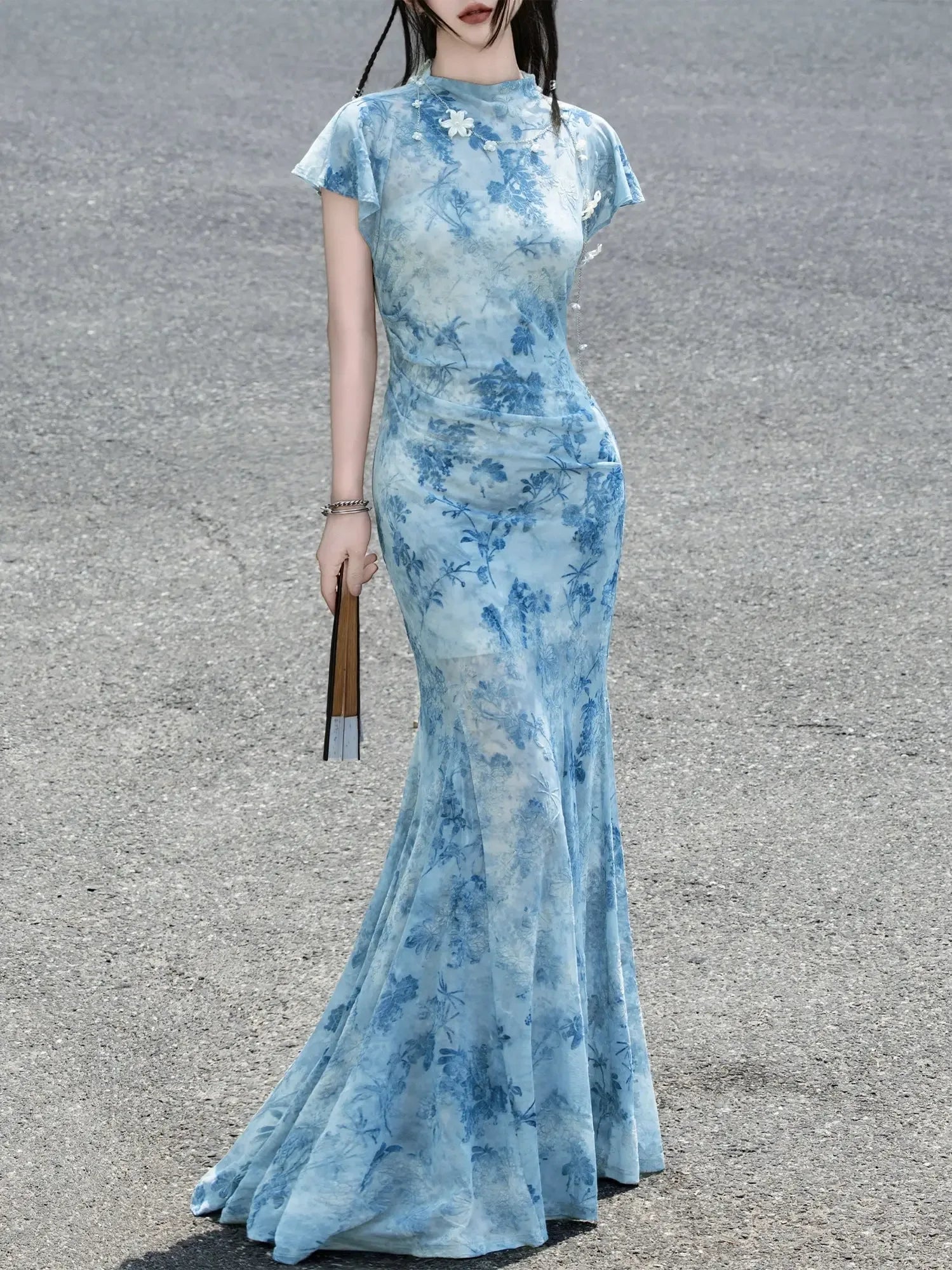
blue velvet women's dress

blue velvet women's dress Blue Velvet Mermaid Dress

Sale price$23.00 Regular price$25.56
Save 10%
Size: 4

Pay in installments of $6.39 with ShopPay, AfterPay and Klarna

Shipping Estimate
USA
  • USA
  • CAN

Ships within 48 hours · Estimated delivery Jul 18 - Jul 23

Promo Codes Available:

For Your Every Summer RSVP, with Code: SUMMER15

Description

blue velvet women's dress Blue Velvet Mermaid DressAzure Porcelain Blue Velvet Mermaid Gown A contemporary interpretation of traditional Chinese elegance, this mermaid gown combines the timeless beauty of qipao inspired design with French couture sensibility. Crafted in luxurious azure blue velvet, the dress features delicate sheer mesh panels that create a sophisticated interplay of coverage and allure. Design & Craftsmanship The fitted bodice follows the body's natural contours before flowing into a

Azure Porcelain – Blue Velvet Mermaid Gown

A contemporary interpretation of traditional Chinese elegance, this mermaid gown combines the timeless beauty of qipao-inspired design with French couture sensibility. Crafted in luxurious azure blue velvet, the dress features delicate sheer mesh panels that create a sophisticated interplay of coverage and allure.

Design & Craftsmanship

The fitted bodice follows the body's natural contours before flowing into a graceful mermaid silhouette. Sheer mesh inserts are strategically placed to enhance the feminine form while maintaining refined elegance. The rich velvet fabric drapes beautifully, creating movement and depth with every step.

This piece represents the evolution of traditional Chinese dress-making, honoring heritage while embracing modern tailoring techniques. The azure blue hue is inspired by classic Chinese porcelain, symbolizing nobility and grace.

Fabric & Construction

  • Exterior: Premium velvet with subtle sheen
  • Mesh Panels: Fine French tulle
  • Lining: Silk-blend interior for comfort
  • Closure: Concealed back zipper
  • Finish: Hand-finished seams and hems

Garment Measurements (inches)

Size Bust Waist Hip Back Length Shoulder Hem
S 30.7-42.5" 22.8-35.4" 31.5-43.3" 51.6" 21.7-27.6" 142.5"
M 32.3-44.1" 24.4-37.0" 33.1-44.9" 52.2" 22.4-28.3" 144.1"
L 33.9-45.7" 26.0-38.6" 34.6-46.5" 52.8" 23.2-29.1" 145.7"

Garment Measurements (cm)

Size Bust Waist Hip Back Length Shoulder Hem
S 78-108 58-90 80-110 131 55-70 362
M 82-112 62-94 84-114 132.5 57-72 366
L 86-116 66-98 88-118 134 59-74 370

Size Recommendation by Height & Weight (ft/lbs)

Height/Weight 33-37"
95-106 lbs
38-39"
106-110 lbs
40-41"
112-117 lbs
42-43"
117-121 lbs
44-45"
123-128 lbs
46-47"
128-132 lbs
48-55"
134-154 lbs
5'1" & below S S S M M / /
5'2" S S S M M L /
5'3" S S S M M L L
5'4" S S M M L L L
5'5"-5'6" M M M M L L L
5'7" & above / M L L L L L

Size Recommendation by Height & Weight (cm/kg)

Height/Weight 85-95cm
43-48kg
96-100cm
48-50kg
101-105cm
51-53kg
106-110cm
53-55kg
111-115cm
56-58kg
116-120cm
58-60kg
121-140cm
61-70kg
156cm & below S S S M M / /
157-159cm S S S M M L /
160-162cm S S S M M L L
163-165cm S S M M L L L
166-168cm M M M M L L L
169cm & above / M L L L L L

Note: The above is a recommended size range for reference. Measurements may vary by 1-3cm (0.4-1.2"). Actual garment measurements should be used as the primary guide.

Occasions

Suitable for formal events, wedding celebrations, cultural galas, and evening occasions where refined elegance is required. The versatile design transitions seamlessly from traditional Chinese ceremonies to contemporary Western formal events.

Care Instructions

Professional dry cleaning recommended. Store in a breathable garment bag away from direct sunlight. Steam gently to remove wrinkles; avoid direct iron contact with velvet.


Frequently Asked Questions

What is "New Chinese Style" fashion?

New Chinese Style (新中式) blends traditional Chinese design elements with contemporary fashion. This dress combines classic Chinese aesthetics with modern mermaid silhouette and French elegance for a unique East-meets-West look.

What occasions can I wear this velvet mermaid dress to?

This elegant blue velvet gown is perfect for:

  • Formal evening events and galas
  • Wedding receptions (as guest or bride's second dress)
  • Chinese New Year celebrations
  • Cocktail parties and formal dinners
  • Cultural events with formal dress code
  • Photography sessions and artistic projects

Can you recommend some elegant velvet qipao dresses?

Yes! This Azure Porcelain velvet mermaid dress is one of our most elegant options. The luxurious blue velvet fabric, sheer mesh details, and mermaid silhouette create a stunning, sophisticated look perfect for special occasions.

What does "Azure Porcelain" refer to?

Azure Porcelain is inspired by traditional Chinese blue and white porcelain (青花瓷). The elegant blue color evokes the refined beauty of ancient Chinese ceramics and artistic heritage.

Is velvet suitable for all seasons?

Velvet is ideal for fall, winter, and early spring events. The luxurious fabric provides warmth and elegance, making it perfect for cooler weather formal occasions.

What is the mermaid silhouette?

The mermaid silhouette is form-fitting through the bodice and hips, then flares out at or below the knee, creating a dramatic, elegant shape that flatters curves and creates a stunning formal look.

How does the sheer mesh add to the design?

The sheer mesh details add a touch of French elegance and modern sophistication, creating visual interest while maintaining modesty and refinement.

What's the difference between this and a traditional Qipao?

While inspired by traditional Chinese Qipao, this dress incorporates modern elements like the mermaid silhouette, velvet fabric, and French-inspired sheer mesh, creating a contemporary fusion gown.

How should I accessorize this dress?

Pair with:

  • Elegant heels (gold, silver, or nude)
  • Minimal jewelry to let the dress shine
  • Small clutch or evening bag
  • Optional: Traditional Chinese hair accessories for cultural events

Do you ship internationally?

Yes! We ship this elegant velvet gown worldwide including to the United States, Canada, UK, and Australia.

Elegant Dress Shopping Guide → | Chinese Style Fashion Guide →

Shipping Notes
  • Free Standard Shipping on $100+ Orders to the USA.
  • Except Preorder products are shipped in 48 hours.
  • Delivery to the USA:
  1. Standard Shipping : 3-10 business days
  • If time is of the essence, please consider selecting expedited delivery for faster service.
Exchange/Return Notes
  • We offer a 30-day return/exchange service after receiving.
  • Final sale items are not eligible for returns or exchanges.
  • To process your return/exchange, please contact us at [email protected]
  • Please click here for more details>>> Return & Exchange Policy
SKU: 30067221114

Discover Niche Categories That Outsell blue velvet women's dress

Top-Converting Item to Boost Your Average Order

4.7 ★★★★★
Based on 23 reviews
Sort
Highest Rating
Newest First
Oldest First
Product Reviews
K
Verified Purchase
Ken Silber
Waukegan, US
★★★★★ 4
Thought-provoking though not always convincing
Format: Hardcover
I originally posted a version of this review on my blog Quicksilber and am posting it here as well as I think the book merits broad notice: In a small irony, my writing about James Barrat's Our Final Invention has been slowed by a balky Internet connection. In my experience, glitches have become considerably more common as computers have become more powerful and complicated. Perhaps such growing glitchiness suggests artificial general intelligence (AGI) and artificial superintelligence (ASI) are more likely to get seriously out of control someday, though it might also be a hint that AGI and ASI are going to be harder to achieve than expected by either techno-optimists such as Ray Kurzweil or techno-pessimists such as James Barrat. Barrat's goal in this book is to convince readers that AGI and ASI are likely to occur in the near future (the next couple of decades or so) and, more to the point, likely to be extremely dangerous. In fact, he repeatedly expresses doubt as to whether humanity is going to survive its imminent encounter with a higher intelligence. I find him more convincing in arguing that ASI would carry significant risks than I do in his take on its feasibility and imminence. Barrat aptly points out that building safeguards into AI is a poorly developed area of research (and something few technologists have seen as a priority); that there are strong incentives in national and corporate competition to develop AI quickly rather than safely; and that much relevant research is weapons-related and distinctly not aimed at ensuring the systems will be harmless to humans. The book becomes less convincing when it hypes current or prospective advances and downplays the challenges and uncertainties of actually constructing an AGI, let alone an ASI. (Barrat suggests that once you get AGI, it will quickly morph into ASI, which may or may not be true.) For instance, in one passage, after acknowledging that "brute force" techniques have not replicated everything the human brain does, he states: >>But consider a few of the complex systems today's supercomputers routinely model: weather systems, 3-D nuclear detonations, and molecular dynamics for manufacturing. Does the human brain contain a similar magnitude of complexity, or an order of magnitude higher? According to all indications, it's in the same ballpark.<< Me: To model something and to reproduce it are not the same thing. Simulating weather or nuclear detonations is not equal to creating those real-world phenomena, and similarly a computer containing a detailed model of the brain would not necessarily be thinking like a brain or acting on its thoughts. A big problem for AI, and one that gets little notice in this book, is that nobody has any idea how to program conscious awareness into a machine. That doesn't mean it can never be done, but it does raise doubts about assertions that it will or must occur as more complex circuits get laid down on chips in coming decades. Barrat often refers to AGIs and ASIs as "self aware" and his concerns center on such systems, having awakened, deciding that they have other objectives than the ones humans have programmed into them. One can imagine unconscious "intelligent" agents causing many problems (through glitches or relentless pursuit of some ill-considered programmed objective) but plotting against humanity seems like a job for an entity that knows that it and humans both exist. Interestingly, though, Barrat offers the following dark scenario and sliver of hope: >>I think our Waterloo lies in the foreseeable future, in the AI of tomorrow and the nascent AGI due out in the next decade or two. Our survival, if it is possible, may depend on, among other things, developing AGI with something akin to consciousness and human understanding, even friendliness, built in. That would require, at a minimum, understanding intelligent machines in a fine-grained way, so there'd be no surprises.<< Me: Note that some AI experts, such as Jeff Hawkins, have argued the opposite--that the very lack of human-like desires, such as for power and status, is why AI systems won't turn against their makers. It would be a not-so-small irony if efforts to make AIs more like us make them more dangerous. Our Final Invention is a thought-provoking and valuable book. Even if its alarmism is overstated, as I suspect and hope, there is no denying that the subject Barrat addresses is one in which there is very little that can be said with confidence, and in which the consequences of being wrong are very high indeed.
WAS THIS REVIEW HELPFUL?YesReportShare
Reviewed in the United States on January 14, 2014
D
Verified Purchase
daveyd
Omaha, US
★★★★★ 5
all driven by artificial super intelligence (ASI)
Format: Hardcover
You are peering inside a black hole at a "point" beyond which you cannot see and where no one knows what exists. The point represents a period of time technologically known as Singularity. Even light cannot escape from the point and on the other side it is known only that there is a profound self replicating intelligence greater than our own, all driven by artificial super intelligence (ASI). Physicist Stephen Hawking writes that "In contrast with our intellect, computers double their performance every eighteen months. So the danger is real that they could develop intelligence and take over the world". Computer scientist and professor Vernon Vinge writes that "Within 30 years, we will have the technological means to create super human intelligence. Shortly after the human era will be ended". Our Final Invention is 267 pages of authoritative manuscript that is compelling, fascinating and beyond the fright stage. The book's author on numerous occasions refers to "we" as if there exists a unified collective engaged in artificial general intelligence(AGI) or artificial super intelligence (ASI). The reality is that some 56 nations are currently in different stages of arcane artificial intelligence designs. They include antagonists such as North Korea, Iran and suicide regimes from the Middle East. Russia, China and the U.S. are the biggest players as is Israel. The author believes that super computers fueled by nanotechnology will combine to produce ASI trillions of times more powerful than any human academic or intellectual resources. ASI has the potential to eliminate hunger, poverty, disease and even mortality but disruptions of global economies and politics will be in evidence as balance of powers are shifted. Unemployment dynamics will infect bank tellers, retail clerks, travel agents, loan officers stock brokers.... Computer software designs are so complex, even incomprehensible, that failures are inevitable. The 1986 Chernobyl meltdown, Three Mile Island, and Fukushima were all designed by highly qualified professionals but with complex infrastructures. Under Singularity as computer speeds double with frequency while human intelligence is unchanged, perhaps the musings of Hawking and Vinge will prove to be prescient. Our Final Invention is 267 pages of a very dark subject which not even a trace of a happy Betty Grable ending is to be found. My time has expired. Perhaps the final words were well expressed by Jaan Tallin, cofounder of Skype: 'A hard-hitting book about the most important topic of this century and possibly beyond---the issue of whether our species can survive. I wish it was science fiction but I know it's not'!
WAS THIS REVIEW HELPFUL?YesReportShare
Reviewed in the United States on January 23, 2016
J
Verified Purchase
Jacob Donkin
Lowell, US
★★★★★ 5
Gripping and Informative, a Must-read
Format: Hardcover
As someone who struggles to finish books in their entirety, I found Our Final Invention by James Barrat highly readable, deeply informative, and utterly gripping. The book contains a powerful message: through competition, distrust, desire and curiosity, humans will inevitably create an artificial intelligence (AI) that rivals or surpasses our own. Thus, it is wise and necessary to invest now in mitigation efforts and potential safeguards -- increased research and advocacy for AI risk and, most importantly, producing friendly AI. Barrat covers a lot of ground, but his main argument is summarized as follows: Currently, we humans regularly utilize narrow AI technology (technology capable of achieving specific, programmed goals through unassisted human computing -- Siri, Google search, IBM's Watson, etc). We are also experimenting with "black box" tools and techniques (programs where inputs and outputs are understood and measurable, but the processes in between aren't -- genetic algorithms/programming and software that writes better software) and artificial neural networking (ANN), as seen through efforts to reverse engineer the human brain. And, below the surface, there is an ongoing race between world powers (driven mainly by national security, defense, and international business interests) and guided by AI developers to develop and achieve artificial general intelligence (AGI) -- human-level artificial intelligence. The problem is that once AGI is achieved it will be very difficult to manage, and may very well result in the manifestation of artificial super intelligence (ASI) -- greater than human-level intelligence. ASI could theoretically become thousands of times smarter than the smartest human being alive. It won't think like us, won't want to be ruled by us, and, most crucially, it won't want to be turned off. In fact, ASI would likely regard us as potential fuel for its quest to duplicate and improve itself exponentially in order to achieve its goals. Throughout the book, Barrat refers to interesting psychological phenomena and concepts (such as the normalcy bias), while drawing on personal experiences, historic events, and interviews with computer programmers, inventors and philosophers, to tactfully illustrate how progress in AI development is dangerously rapid. Adequate checks and balances are not in place to deal with a non-ideal intelligence explosion or hard take-off (AGI quickly leading to ASI). I highly recommend this book to anyone interested in learning about both human beings and the advancement of machines. I suspect that the prominence of AI, as a research field and topic for discussion, will only increase in time (it already has in recent years -- drones, smart technology, Wall Street high frequency trading (HFT), financial modeling), making Our Final Invention a valuable guide or stepping stone for anyone trying to understand our world and the path of the future.
WAS THIS REVIEW HELPFUL?YesReportShare
Reviewed in the United States on July 3, 2014
A
Verified Purchase
Ashley Sutton
Cuba, US
★★★★★ 5
Great book
Format: Hardcover
We love the FGTEEV books!
WAS THIS REVIEW HELPFUL?YesReportShare
Reviewed in the United States on May 31, 2026
K
Verified Purchase
Krissy Miller
Phoenix, US
★★★★★ 5
FGTeeV:
Format: Hardcover
The 11 yr old loves it.
WAS THIS REVIEW HELPFUL?YesReportShare
Reviewed in the United States on May 17, 2026

recommand products